Monday, June 30, 2008

Perry 15: LaFontaine's Fox and Grapes in Latin

One of the greatest finds I made in the past couple of weeks at Google Books is an old Latin textbook: Porta Latina: A Reading Method, for the Second Year; Fables of LaFontaine in a Latin Version, by Frank Gardner Moore (Professor of Classical Philology at Columbia University), published in 1915. It is a fabulous little book! Next summer I think I may attempt to republish it with Lulu.com. There are many public domain books that have been reprinted and are available for sale at Amazon and other online booksellers, but it does not look like any of the re-publishers have made this one available yet. I think it would be a wonderful book to have available to teachers and students in printed form!

There are so many things I like about this book. First, the fables as adapted from LaFontaine are fun and lively. LaFontaine was one of the most gifted storytellers in the Aesopic tradition, and turning his French poetry into Latin prose yields some excellent reading material for students, which can then be connected with classical, medieval, and Renaissance Latin versions of the same stories which LaFontaine has told. Moore has chosen 50 fables for the book, some of which are classical Aesop's fables, and some of which represent the eastern fables which LaFontaine helped to popularize in the European tradition. You can see the contents of the book listed here, with links to the individual fables.

The fables are presented with macrons for the long vowels and some very helpful raised dots to help students find the natural pauses when they read. This is an economical way to achieve the same thing I try to achieve with my "segmented" way of presenting Latin texts (anyone who has been reading this blog is familiar with the way I do that). There is a glossary in the back of the book, and there are also notes for each fable, plus an introduction that outlines some good strategies for reading Latin prose. My only disappointment with the book is that the notes do not take a systematic approach to some admittedly challenging Latin constructions. If I do get around to republishing the book, I would probably want to supplement the notes, just to make sure students get all the help they need if they are stymied in their understanding of the Latin.

Anyway, to give you a sense of this delightful book, here is one of the first fables it includes, a very short one: the story of the fox and the grapes, a classical Aesop's fable which actually gives us the modern catch-phrase "Sour grapes," although few people know anymore that the story comes from Aesop. Here is Moore's Latin prose version of the story - I've tried to reproduce here his elegant solution to including the pauses in the story (although I have not included the macrons):
Vulpes quaedam · fame confecta, uvas · de pergula pendentes · maturas, ut videbatur, et purpureas · conspicata, eas · quamvis cupida · attingere non poterat. Itaque · "Acerbae" · inquit · "adhuc sunt, calonibus tantum · maturae!" Num melius fuisset · gemere ac lamentari?
The two unusual words here are glossed as follows in the complete glossary provided in the back of the book. As you can see, the glossary make some effort to promote an etymological understanding of Latin word derivation by referencing the verb pergo for the noun pergula. Nice!
calo, calonis (m.): camp-follower, servant
pergula, pergulae (pergo): projection, shed, arbor, trellis, pergola
You can see that as he has rendered LaFontaine in Latin prose, Moore has still managed to convey some of the spirit of LaFontaine's original French verse (with Moore's calones standing in for LaFontaine's goujats, for example):
Certain Renard Gascon, d'autres disent Normand,
Mourant presque de faim, vit au haut d'une treille
Des Raisins mûrs apparemment,
Et couverts d'une peau vermeille.
Le galand en eût fait volontiers un repas ;
Mais comme il n'y pouvait atteindre :
"Ils sont trop verts, dit-il, et bons pour des goujats. "
Fit-il pas mieux que de se plaindre ?
As you can see, LaFontaine takes the approach to this story that you see also in Steinhowel's version, suggesting that it might be psychologically positive for someone to just say "sour grapes," as the fox does, rather than to torture themselves with regret and remorse for something they cannot have. Other versions of the story, of course, criticize the fox for being a hypocrite, someone who criticizes the grapes only because they are out of reach. Those grapes look very good indeed, after all, something not just suitable for Latin calones and French goujats!

For a complete list of the version of this fable that I have found, see del.icio.us/aesopus/perry015. (Yes, I've decided to start cataloging the fables with del.icio.us tags - I'll be explaining more about that in future posts!)

For an illustration, here is the fox leaping at some very tempting-looking grapes in Osius's Aesop:


For more information about subscribing to this blog via RSS or by email, visit the Bestiaria Latina blog using the link provided here.

Friday, June 27, 2008

Perry 169: Young Man and Swallow

With the growing number of fables, I've decided I need a more automated tagging system to keep up with all the content, so I've decided to start using del.icio.us again in order to keep track of the fables! I've created a user account, aesopus, so here you can see all the fable items I have tagged with today's selection, Perry 169: Young Man and Swallow.

This is not found in an ancient Latin source, so it enters the tradition only as the Greek fables begin to be translated in the Renaissance and later. As a sample of the fable in Latin, I've chosen a version from the 16th-century poet, Candidus Pantaleon. The poem is in iambic meter, and you will want to watch out for a few unfamiliar lexical items: heluo (helluo) is a glutton; paenula is a hooded cloak; abligurio (abligurire) is to squander; Caurus is the northwest wind.

Vestes suas quidam abligurivit heluo,
Brumae sub horam, et una restebat modo
Paenula. sed ille veris indicem videns
Hirundinem, decoxit illam et paenulam,
Aestate ea quasi esset indigus parum.
Sed falsus est? nam Caurus acri frigore
Spirans inhorruit grave. ille ibi, heu, miser,
Frigens, dolensque semi oberrat mortuus.
Torpore confectam deinde hirundinem
Cum cerneret iacere: ibi exsultans ait:
Infausta avis; non veris es, sed frigoris
Praenuntia, et poenas merito luis tuas.
Me teque noxa hac perdidisti pessima.
Non una ver hirundo fulgens efficit.
Non bolus unus improbam sidat famem,
Res una iuste quaeque fiat tempore.


Here is the poem rewritten in a more prose-like word order to help you see how it fits together:

heluo quidam
vestes suas abligurivit,
sub horam brumae,
et restebat modo
una paenula.
sed ille
videns hirundinem, veris indicem,
decoxit et illam paenulam,
quasi esset parum indigus
ea aestate.
sed falsus est?
nam Caurus
acri frigore spirans
inhorruit grave.
ille ibi, heu,
miser frigens dolensque,
oberrat semi mortuus.
deinde,
cum cerneret
iacere hirundinem
torpore confectam,
ibi exsultans ait:
infausta avis;
non veris,
sed frigoris praenuntia es,
et poenas tuas merito luis.
me teque
perdidisti
pessima hac noxa.
non hirundo una
fulgens ver efficit.
non bolus unus
improbam famem sidat,
res una quaeque
iuste fiat tempore.

I really like the comparison of the hirundo una to the bolus unus at the end - that definitely reminds us of how the young man has gambled away all his wealth.

For an illustration, here is an image from Thomas Bewick's Aesop, published in 1818 - although this is an ancient Aesop's fable, you can see the young man dressed in early 19th-century clothes; the young man who gambles away all he has is, unfortunately, one of those timeless stories:


For more information about subscribing to this blog via RSS or by email, visit the Bestiaria Latina blog using the link provided here.
Thursday, June 26, 2008

Perry 158: Wolf and Nurse

With the growing number of fables, I've decided I need a more automated tagging system to keep up with all the content, so I've decided to start using del.icio.us again in order to keep track of the fables! I've created a user account, aesopus, so here you can see all the fable items I have tagged with today's selection, Perry 158: Wolf and Nurse.

This fable enters the Latin tradition through Avianus, not through Phaedrus, so you will not find many Latin examples prior to the Renaissance, when the Greek fables began to be translated into Latin. As a sample of the fable in Latin, I've chosen a version from an 18th-century schoolbook prepared for the boys of Eton (the book contains the fables in both Greek and Latin). Here is that Latin version of today's story, Lupus et Vetula:

Lupus esuriens circuibat, quaerens cibum. Profectus autem ad locum quendam, audivit puerulum lugentem, et anum dicentem ei: Desine plorare; sin minus, hac hora tradam te Lupo. Ratus igitur Lupus quod serios loquitur anicula, stetit multam expectans horam. Sed cum oppressisset vespera, audit rursus anum blandientem puerulo ac dicentem ei: Si venerit Lupus huc, interficiemus, O fili, eum. His auditis, Lupus abivit, dicens: In hoc tugurio aliud dicunt, aliud vero faciunt. Affabulatio. Fabula in homines, qui facta verbis non habent similia.

For easier reading, here is a segmented version:

Lupus esuriens
circuibat,
quaerens cibum.
Profectus autem
ad locum quendam,
audivit puerulum lugentem,
et anum dicentem ei:
Desine plorare;
sin minus,
hac hora tradam te Lupo.
Ratus igitur Lupus
quod serios loquitur anicula,
stetit
multam expectans horam.
Sed cum oppressisset vespera,
audit rursus anum
blandientem puerulo
ac dicentem ei:
Si venerit Lupus huc,
interficiemus, O fili, eum.
His auditis,
Lupus abivit,
dicens:
In hoc tugurio
aliud dicunt,
aliud vero faciunt.
Affabulatio.
Fabula in homines,
qui
facta verbis non habent similia.

I especially like the balance in this story between the old woman's harsh words to the boy at first, and then the soothing words, about how they are going to kill that nasty old wolf! In many versions of the story, the moral is explicitly misogynistic, about how it is women who cannot be trusted. This fable neatly avoids that trap, and draws a more general moral about hypocrites of either gender!

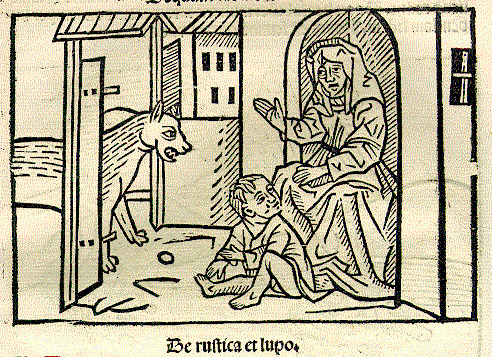
For an illustration, here is an image from Steinhowel's Aesop:


For more information about subscribing to this blog via RSS or by email, visit the Bestiaria Latina blog using the link provided here.